Rebranding is one of the most commonly misunderstood investments a business can make. Across Singapore’s SME landscape, we see businesses investing in new logos, refreshed colour palettes, and redesigned websites — and then wondering why enquiry quality hasn’t improved. The reason is almost always the same: they redesigned the expression without rethinking the strategy.

The Difference Between a Brand and a Logo
A logo is the visual symbol of a brand. A brand is something far larger and more commercially powerful:
Your brand is the reason a potential customer chooses you over a competitor who may be cheaper. It is the perception people hold of your business — before they speak to you, before they read your proposal, before they make any decision. That perception is shaped by every touchpoint: your website, your social media, how your team communicates, your pricing, your service experience, and yes — your logo.
When the brand strategy is strong, all of those touchpoints reinforce a clear, consistent message. When the strategy is weak or absent, even a beautifully designed logo cannot carry the weight.
Three Brand Problems Bluehive Sees Most Often in Singapore SMEs
- Positioning drift: The business has evolved significantly — new services, new clients, expanded capabilities — but the brand messaging still reflects what the company was three years ago. Marketing amplifies an outdated story.
- Audience mismatch: The brand is communicating to a broad, undefined audience instead of speaking specifically to the decision-makers the business actually wants to attract.
- Inconsistency: Different team members describe the business differently. The website, LinkedIn page, and sales pitch all tell slightly different stories — eroding the trust that branding is supposed to build.
What Brand Strategy Actually Involves
A proper brand strategy engagement covers:
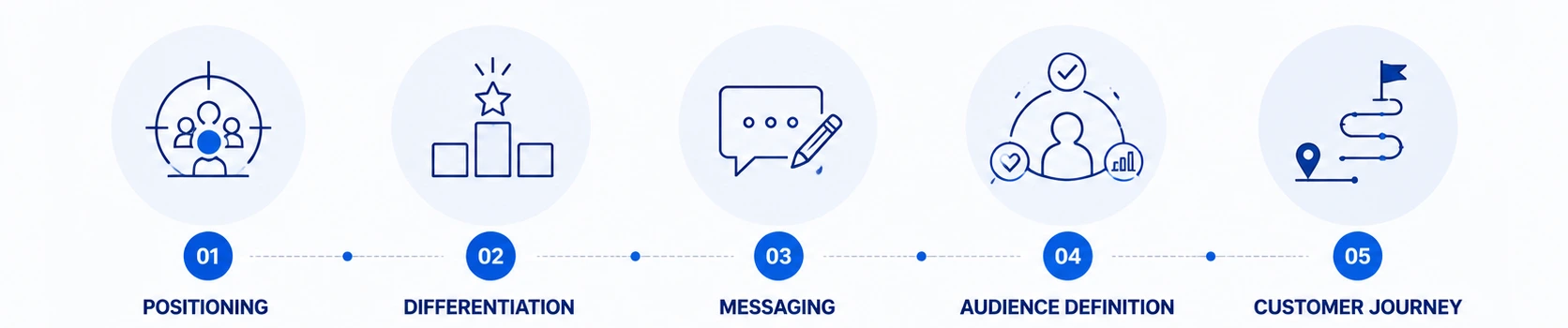
- Positioning: What specific problem do you solve, for whom, and why are you the best choice?
- Differentiation: What makes your business genuinely different from competitors — beyond price and service quality?
- Messaging: What is the core narrative your business tells across every channel and touchpoint?
- Audience definition: Who exactly is your target client — their role, their pain points, their decision-making context?
- Customer journey: What does a potential client experience from first awareness through to conversion and beyond?
Only once these strategic foundations are clear should design, content, and marketing execution begin. Design is the last step — not the first.
When Rebranding Is the Right Decision
A rebrand is strategically appropriate when:
- The business has significantly expanded its services or target market
- The current brand is creating confusion with competitors or in the market
- The business is entering a new segment or geography
- Leadership has changed and the brand needs to reflect a new direction
- The existing brand actively undermines trust or quality perception
Rebranding for aesthetic reasons — because the team is bored of the current logo, or because a competitor has rebranded — is rarely a sound commercial investment.
The Commercial Impact of Strong Brand Positioning
Bluehive’s work with Singapore SMEs across F&B, retail, logistics, and professional services consistently demonstrates that clear brand positioning produces measurable commercial outcomes:
Marketing spend works harder — ads and content resonate more strongly when the message is specific and the audience is clearly defined. Conversion rates improve — potential clients are more likely to enquire when they immediately understand what the business does and why it’s relevant to them. Pricing holds up — businesses with strong differentiation face less price pressure than those competing on generic value propositions.
Bluehive helps Singapore SMEs build brand strategy that drives commercial results — not just aesthetics. If your business has evolved significantly in the past two to three years, it may be time for a positioning review. Read more at www.bluehiveasia.com
Contact Bluehive Consulting Asia
www.bluehiveasia.com | info@bluehiveasia.com | +65 9191 9682