
The most commercially resilient Singapore SMEs Bluehive has worked with over the past decade share a defining characteristic: they do not treat business transformation as a collection of separate projects. They connect strategy across people, process, brand, and technology — and the results speak for themselves.
The Siloed Transformation Problem

The typical SME transformation journey looks something like this:
Year 1: The business invests in a new digital system or AI tool.
Year 2: The business embarks on a rebranding exercise.
Year 3: The business applies for a CTC grant and does some job redesign.
Year 4: ESG becomes unavoidable and gets added to the list.
Each initiative is managed separately, with different consultants, different timelines, and different objectives. The result is fragmented transformation — where each project may be technically successful but fails to compound into sustainable competitive advantage.
How Connected Transformation Works
When transformation is approached as an interconnected strategy, each pillar reinforces the others:
- AI adoption is more effective when job roles are redesigned around new workflows — people and technology moving together
- Brand positioning is more credible when it reflects operational reality — including genuine ESG practices and AI-enabled service quality
- ESG is more sustainable when it is embedded in operations, workforce practices, and business model — not bolted on as a reporting exercise
- Workforce capability development is more impactful when it is tied to specific workflow changes, technology adoption, and business direction
What This Looks Like for a Singapore SME
Consider a mid-sized Singapore logistics company facing rising manpower costs, pressure to digitalise, and growing enterprise client ESG requirements.
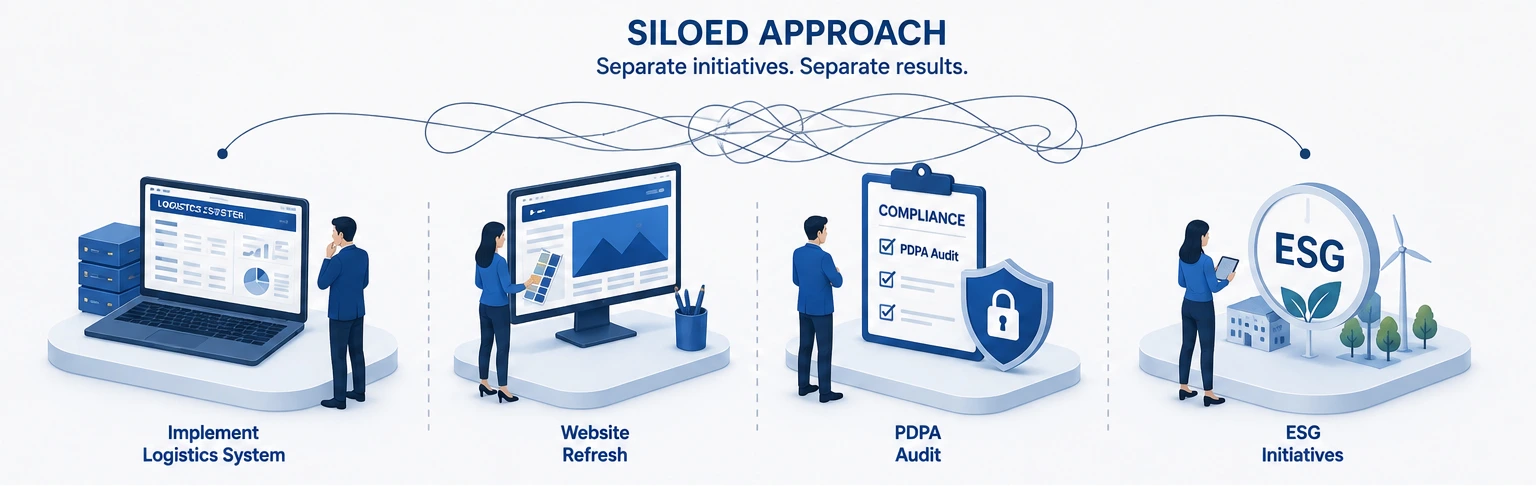
A siloed approach would address each of these separately: hire a vendor to implement a logistics management system, engage a design agency for a website refresh, and commission a compliance firm for a PDPA audit.
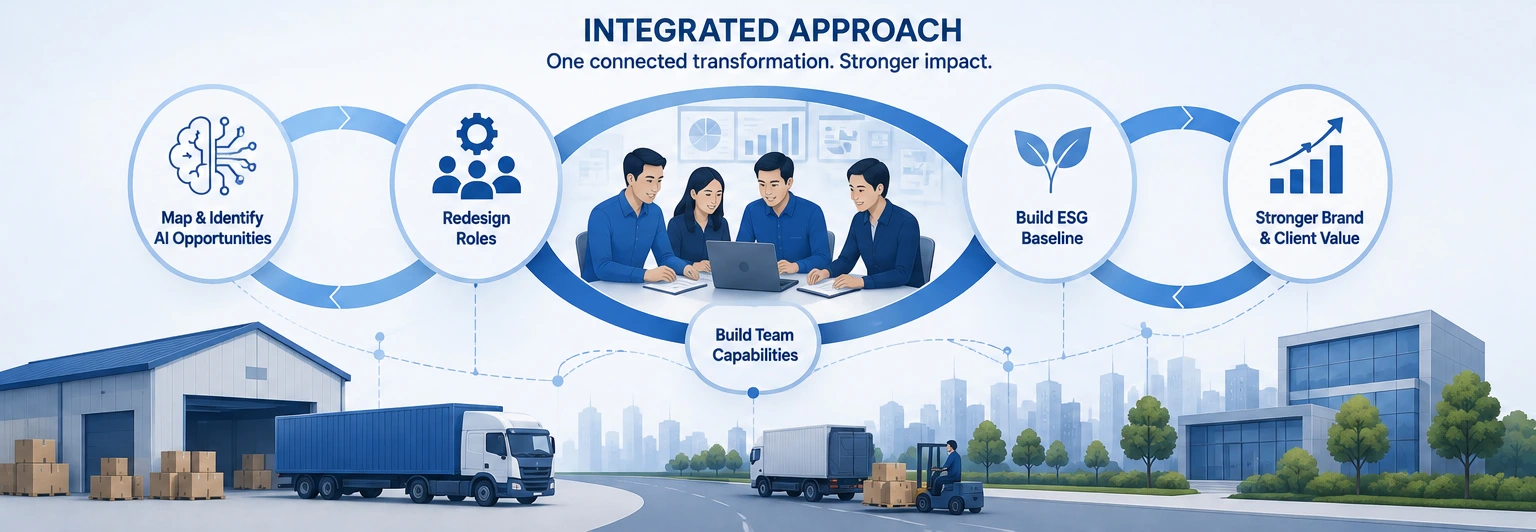
An integrated approach — the Bluehive model — addresses them as one connected transformation: mapping workflows to identify AI automation opportunities, redesigning roles to reflect the new operational reality, building an ESG baseline that strengthens the brand’s enterprise client positioning, and developing the team’s capabilities to sustain and build on the transformation.
The Business Case for Integration
- Cost efficiency: Integrated transformation eliminates redundant consulting fees, avoids rework from misaligned projects, and maximises the compound value of each investment
- Grant optimisation: Singapore’s EDG, CTC, and ESG-related funding programmes are more effectively utilised when projects are structured around a coherent transformation roadmap
- Faster ROI: Each pillar accelerates the value of the others — AI is faster to adopt when processes are redesigned; marketing ROI improves when positioning is clear; ESG credentials open commercial doors faster when operationally grounded
- Competitive resilience: Businesses that connect their transformation strategy are significantly harder for competitors to replicate
Bluehive partners with Singapore SMEs to design and implement connected transformation across AI, branding, ESG, and workforce capability — as one coherent strategy, not four separate projects. Read more at www.bluehiveasia.com
Contact Bluehive Consulting Asia
www.bluehiveasia.com | info@bluehiveasia.com | +65 9191 9682


